Note
Go to the end to download the full example code.
2D Clustering with SomVQ
Demonstrates unsupervised clustering on synthetic 2D data using SomVQ.
Because the data is 2-dimensional, both the input points and the learned
neuron positions can be visualized in the same space.
Train SomVQ
SomVQ is the unsupervised variant of DBGSOM — no class labels needed.
Key hyperparameters:
lambda_=15.8: regulation coefficient for the growing threshold — lower values produce more neurons (equivalent to the formerspreading_factor=0.9)max_neurons=200: upper bound on neuron countsigma_end=0.9: neighborhood radius at end of training
from pathlib import Path

import matplotlib.pyplot as plt
import numpy as np
import seaborn as sns
from sklearn.preprocessing import scale

from dbgsom.SomVQ import SomVQ

data = scale(np.load(Path("data") / "clusterable_data.npy"))

som = SomVQ(
    n_iter=500,
    lambda_=15.8,
    sigma_end=0.9,
    random_state=32,
    max_neurons=200,
)
som.fit(data)
Network Visualization
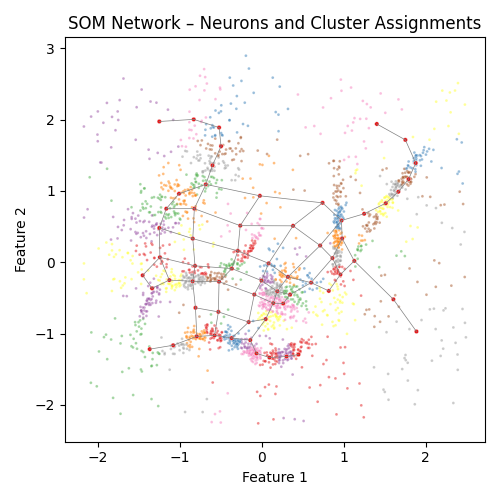
Input data colored by cluster assignment; gray lines show neuron connections.
edges = list(som.som_.edges)
weights = som.weights_

fig, ax = plt.subplots(figsize=(5, 5))
for edge in edges:
    ax.plot(
        [
            som.som_.nodes().data()[edge[0]]["weight"][0],
            som.som_.nodes().data()[edge[1]]["weight"][0],
        ],
        [
            som.som_.nodes().data()[edge[0]]["weight"][1],
            som.som_.nodes().data()[edge[1]]["weight"][1],
        ],
        color="gray",
        linewidth=0.5,
    )
sns.scatterplot(
    ax=ax,
    x=data[:, 0],
    y=data[:, 1],
    s=4,
    alpha=0.5,
    hue=som.predict(data),
    palette="Set1",
    legend=False,
)
sns.scatterplot(
    ax=ax,
    x=weights[:, 0],
    y=weights[:, 1],
    hue=[1] * len(som.neurons_),
    palette="Set1",
    s=10,
    legend=False,
)
ax.set_title("SOM Network – Neurons and Cluster Assignments")
ax.set_xlabel("Feature 1")
ax.set_ylabel("Feature 2")
plt.tight_layout()
plt.show()
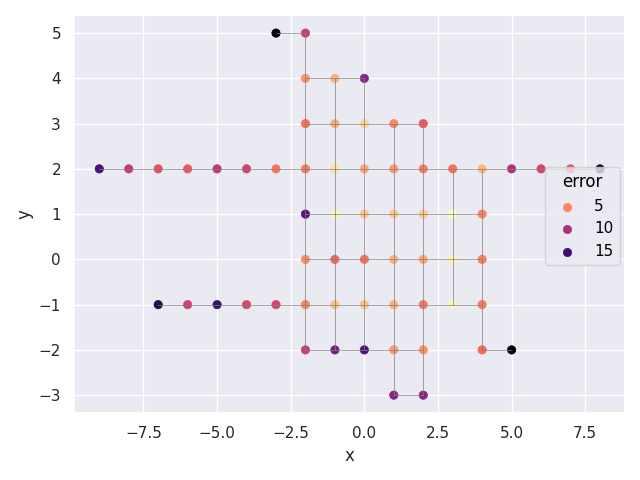
Quantization Error per Neuron
Each neuron colored by mean quantization error — higher error (darker) indicates regions where data density is not well represented.
som.plot(color="error").show()
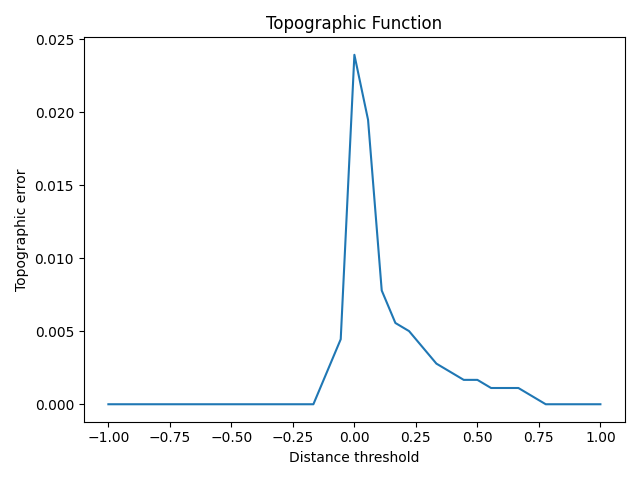
Topographic Function
Topographic error as a function of distance threshold. Lower values indicate better topology preservation.
te = som.topographic_function(data)
fig, ax = plt.subplots()
ax.plot(te[1], te[0])
ax.set_xlabel("Distance threshold")
ax.set_ylabel("Topographic error")
ax.set_title("Topographic Function")
plt.tight_layout()
plt.show()
Total running time of the script: (0 minutes 0.527 seconds)